The new Cosmos series will premiere on Sunday 9th March. As I grew up watching the original Cosmos series and one of my influences has been Carl Sagan, I am waiting so much for this new series. I was excited since I first heard about the new Cosmos, and more so when I learned that Neil DeGrassi Tyson has been selected to host the series. Needless to say, I hope this new series is as good as the old one, and I hope that it will positively influence children and adults alike to learn more about science, our world and the universe. We are made of stardust, as Carl Sagan said, and we ought to learn about stardust and its wonders.
Showing posts with label Science. Show all posts
Showing posts with label Science. Show all posts
Thursday, February 06, 2014
New Cosmos Series
The new Cosmos series will premiere on Sunday 9th March. As I grew up watching the original Cosmos series and one of my influences has been Carl Sagan, I am waiting so much for this new series. I was excited since I first heard about the new Cosmos, and more so when I learned that Neil DeGrassi Tyson has been selected to host the series. Needless to say, I hope this new series is as good as the old one, and I hope that it will positively influence children and adults alike to learn more about science, our world and the universe. We are made of stardust, as Carl Sagan said, and we ought to learn about stardust and its wonders.

Thursday, January 19, 2012
Io's shadow on Jupiter

Beautiful isn't it? This is an image taken by the Hubble Telescope. A telescope that has given us a lot of discoveries, a lot of new information on our solar system, on our galaxy, on the universe in which we live.
Jupiter is the biggest planet of our solar system. It is a gas giant; this means that Jupiter does not have a surface as such; its composition is mostly hydrogen and helium.
The image at the left shows the shadow of Io, one of Jupiter's many moons, as it is cast over on the upper atmosphere of the planet. Io is one of the most volcanically active bodies of our solar system.
For more beautiful photos and more information, you can go to the Hubble Site itself: HubbleSite by NASA.
Tuesday, December 20, 2011
BBC's A Night with The Stars

This lecture had exactly what is needed to popularize physics and to make people understand some of the laws and principles of physics. It was simple to understand, without any big words or convoluted sentences. It was delivered with humour and famous guests, like Simon Pegg. As a wanna-be physicist, and as someone who is deemed weird and eccentric at times, exactly for my love of mathematics and physics, this is the kind of documentary we need. People need to see that physics, and generally science, is not as strange or away from reality as some people think.

I leave you with the Youtube videos of the BBC documentary.
Tuesday, September 07, 2010
Spiral of a dying star
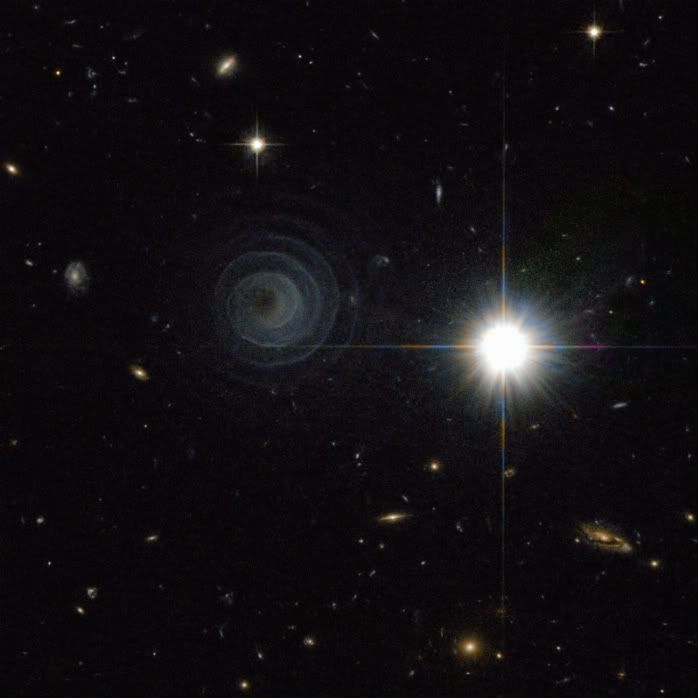
The spiral is made from material ejected by a red giant star, a star that is at the end of its life cycle. It has already burnt all its hydrogen, transformed it through nuclear fusion into helium , and it is now transforming helium into carbon, again through a process of nuclear fusion.
The spiral is due to the fact that the red giant star has a companion, another star, and the gravitational influence of the companion star "pushes" the material into a spiral.
Another very interesting fact is that the spiral is being lit, not by the binary star, but by galactic starlight!
More on the Hubble photograph here: An Extraordinary Celestial Spiral
The short scientific article is here, free for download: A Binary-Induced Pinwheel Outflow from the Extreme Carbon Star, AFGL 3068
Tuesday, July 27, 2010
London and Durham here I come!
Well, it's almost time for me to start packing. It's vacation time. However, this year I am going to spend some of my vacation time doing Physics Experiments. I have registered for the Open University course SXR207 - Physics By Experiment. This is the last year they are giving this course, since the curriculum and the degrees are changing. But, I do not care much about that, I'll be able to transfer my credits to the new degrees anyway, so no problem there.
I will start my journey on Friday morning, from Athens to London. I'll be staying in London for one night, and I already have registered at a hotel for the night. I know London a bit, been there a number of times, and I love it. I love London, especially shopping in London. However, I wish that you guys did not get the Olympic games. It will NOT be any fun, believe me. I've been through the Olympics stuff in Athens in 2004 and it was painful to say the least.
On Saturday, 31st July, in the morning, I'll get up early and get the train to Durham. I've never been to Durham,. and frankly, I don't even know where exactly it is. Always good to see a new place. I hope I'll have some time to see a bit of the town, and any historical monuments or buildings they have, even if it's just a quick tour. I would like to be able to walk a bit around town and see what it has to offer. I know I have one afternoon off, so, if I am not too tired, I'll get to check the town.
Return to London, on Friday the 6th of August, after the end of the residential course. And back to Athens on Saturday the 7th of August. A short but very interesting holiday for me.
I'll get photos from Durham, especially the University. I love English Universities, especially since I did my MSc. in one.
I will start my journey on Friday morning, from Athens to London. I'll be staying in London for one night, and I already have registered at a hotel for the night. I know London a bit, been there a number of times, and I love it. I love London, especially shopping in London. However, I wish that you guys did not get the Olympic games. It will NOT be any fun, believe me. I've been through the Olympics stuff in Athens in 2004 and it was painful to say the least.
On Saturday, 31st July, in the morning, I'll get up early and get the train to Durham. I've never been to Durham,. and frankly, I don't even know where exactly it is. Always good to see a new place. I hope I'll have some time to see a bit of the town, and any historical monuments or buildings they have, even if it's just a quick tour. I would like to be able to walk a bit around town and see what it has to offer. I know I have one afternoon off, so, if I am not too tired, I'll get to check the town.
Return to London, on Friday the 6th of August, after the end of the residential course. And back to Athens on Saturday the 7th of August. A short but very interesting holiday for me.
I'll get photos from Durham, especially the University. I love English Universities, especially since I did my MSc. in one.
Tuesday, November 21, 2006
Crunching Numbers...
In 1999, a Distributed Computing Project, SETI@Home opened and let computers and people from all over the world try to help in the Search for Extra-Terrestrial Intelligence. The project became a huge success with a lot of people, even those who have little experience with computers.
The main idea behind this project was the fact that there are billions of computers connected or with connection capabilities to the internet, which can be used to process data for projects such as SETI. Most computers remain idle and are not used for long periods of time, so their processing capabilities at such times can be used. This gives the projects huge amounts of processing power.
The SETI@Home project was a huge success and people volunteered that unused processing power to help the project. Seeing the success of SETI, more projects have come online and nowadays through the use of a Distributed Computing Client more than one projects can be run at the same time.
The Distributed Computing Client is called BOINC and can be found here: http://boinc.berkeley.edu, along with information on said client, information on available projects and more.
Before I continue talking about Distributed Computing and projects, I will take a moment to explain some of the terms used by the people who donate their PC's processing power to such projects. First of all, WU or WorkUnit is the chunk of data that a computer downloads and processes. Crunching Numbers refers to the processing of such data, since all the computer does is actually process numbers, and providinbg a result for each WorkUnit.
Continuing our discussion, the Distributed Computer Projects have been so successful, that even from the very start people started having contests and competitions as to who would crunch the most data, who would process that number of WUs first, etc. As a result, people started also forming teams and informal contests and competitions started arising between the various teams, but also between members of the same team. There is no prize to whomever wins and there are really no losers in these unofficial games. The winners are always the projects!
You will notice that on right hand side of the blog, I have put the statistics for my projects, and those for my team. This is a way of me saying that it doesn't matter whether you can crunch 10 WUs per day or just one every week, what matters is that you help in those projects that you are interested in. I also am proud of the work that I am doing in that department and the work my team puts in.
The statistics for users and teams of such projects can be found at the BOINC Statistics site.
My team is called "The Knights Who Say Ni!" and I chose the team because everyone is a serious lunatic and madman or madwoman. If you are interested in any distributed computing projects and are a bit (or more) of a looney (bin or not) then come and look at The Knights Who Say Ni!
The main idea behind this project was the fact that there are billions of computers connected or with connection capabilities to the internet, which can be used to process data for projects such as SETI. Most computers remain idle and are not used for long periods of time, so their processing capabilities at such times can be used. This gives the projects huge amounts of processing power.
The SETI@Home project was a huge success and people volunteered that unused processing power to help the project. Seeing the success of SETI, more projects have come online and nowadays through the use of a Distributed Computing Client more than one projects can be run at the same time.
The Distributed Computing Client is called BOINC and can be found here: http://boinc.berkeley.edu, along with information on said client, information on available projects and more.
Before I continue talking about Distributed Computing and projects, I will take a moment to explain some of the terms used by the people who donate their PC's processing power to such projects. First of all, WU or WorkUnit is the chunk of data that a computer downloads and processes. Crunching Numbers refers to the processing of such data, since all the computer does is actually process numbers, and providinbg a result for each WorkUnit.
Continuing our discussion, the Distributed Computer Projects have been so successful, that even from the very start people started having contests and competitions as to who would crunch the most data, who would process that number of WUs first, etc. As a result, people started also forming teams and informal contests and competitions started arising between the various teams, but also between members of the same team. There is no prize to whomever wins and there are really no losers in these unofficial games. The winners are always the projects!
You will notice that on right hand side of the blog, I have put the statistics for my projects, and those for my team. This is a way of me saying that it doesn't matter whether you can crunch 10 WUs per day or just one every week, what matters is that you help in those projects that you are interested in. I also am proud of the work that I am doing in that department and the work my team puts in.
The statistics for users and teams of such projects can be found at the BOINC Statistics site.
My team is called "The Knights Who Say Ni!" and I chose the team because everyone is a serious lunatic and madman or madwoman. If you are interested in any distributed computing projects and are a bit (or more) of a looney (bin or not) then come and look at The Knights Who Say Ni!
Subscribe to:
Posts (Atom)